
Looking For Gifts Along The Way
by Molly Renaud
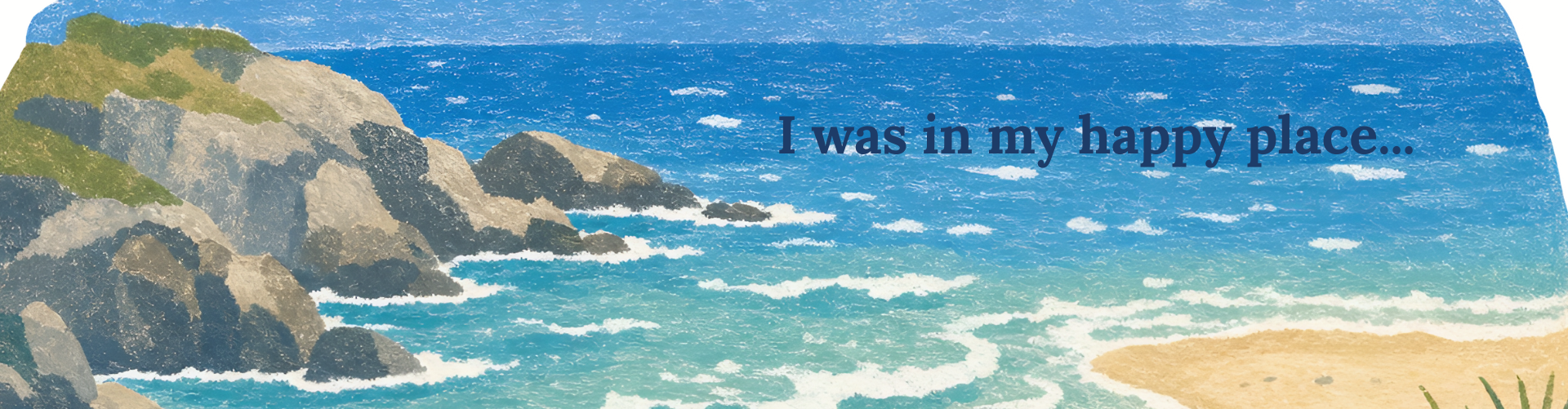
I was in my happy place—twelve miles out to sea, wrapping up a week-long vacation on an island off the coast of Maine—when I heard the words, “You have cancer.”
It was a beautiful week in a place I’ve visited my entire life. The island’s hiking trails are like old friends; its vistas, warm neighbors, salt air, and sea have always been a kind of yearly salvation. My husband and I were celebrating the anniversary of our engagement—he proposed to me on the island nine years earlier. And my daughter, at age seven, hiked the “permittimer” (as she called it) with us. Her little legs made it around the island in just under five hours. Not once did she complain. In fact, she made up songs and stories just to keep moving along the difficult cliff trails.
The news came to me like waves on the island beach: it landed, and then it receded. I would say it out loud—I have cancer—but it wouldn’t sink in. It kept washing away. Like water through a sieve, I tried to hold it, but it poured right through me. It didn’t truly “land” until I returned to the mainland, away from my happy place.
I wanted answers when I reached the mainland. The only person I knew in my immediate circle who’d had breast cancer was a second cousin. I called her, looking for answers: How did you get through treatment? What do I need to do to survive this?
She told me she’d faced a fairly rare and aggressive form of breast cancer when she was around forty. She beat it and was living cancer-free ten years later. And then she said something that, at the time, sounded almost offensive.
“Look for gifts along the way—and celebrate them.”
Gifts? In my mind, I thought, I’ve been handed a death sentence, and you’re telling me to look for gifts? Celebrate? But the phrase stuck. I kept repeating it: Look for gifts along the way. Celebrate them. And she was right. Cousin Patti was right.
Don’t get me wrong—I did my fair share of awfulizing. But whenever I found myself getting too negative, angry, or afraid, I returned to that idea: find the gifts. Celebrate them.
Here’s what I found.
The gift of receiving help
I was six months into my role as Director of Grateful Patient and Family Giving when I received my diagnosis. Talk about the gift of professional development! I worked alongside clinicians and helped raise funds for the medical center, so I could talk openly about cancer with colleagues whose empathy and compassion were unlike anything I’d experienced elsewhere. That support was a gift—it helped me move through treatment without always feeling like “a patient.”
But I remember the moment I finally accepted that I was.
The morning of my lumpectomy, I had a wire placement—a marker to guide my surgeon to the tumor. I’m afraid of needles, and I faint at the sight of blood, so my usual strategy is simple: close eyes, look away, pretend I’m somewhere else.
This time, after the wire was placed, I opened my eyes wide and saw the doctor, nurses, and a medical student huddled in the corner, studying the images together.
And I started to cry—quietly at first, and then all at once.
They were there to help me. They had learned how to do this, and they were teaching someone else, and it was all for the same purpose: to help my surgeon get this tumor out of my body. I didn’t have to earn it or even ask for it. It was simply offered—exactly what I needed.
The doctor noticed my tears, came to my side, and said, “You know you’re going to be okay. You’re going to be okay.”
And for the first time, I believed it. Those tears weren’t fear. They were gratitude—and the relief of letting myself be helped.
The gift of deeper relationships
When I was diagnosed, my daughter was seven. We decided early on that we would talk about it—ask questions, name our feelings, and make room for all of it: tears, worry, even laughter.
I explained what a lumpectomy was, and soon I caught her playing “breast surgeon” with her doctor kit—her way of making sense of something scary. When I started radiation, I told her it would be like a bad sunburn, but one that helps keep the bad cells from coming back. I missed a few softball games, and I didn’t feel up to our annual pre-Christmas trip to the Red Lion Inn, but we talked through the disappointments together.
And we celebrated the wins, too—she helped me ring the bell at the end of treatment, two days before Christmas.
Unbeknownst to me, she even worked with her third-grade teacher to share my story with her class: cancer is scary, but you can talk about your feelings—and screening and early detection can save your life. The “third adult” in our household, indeed—finding her voice and becoming an advocate.
And when we got home from Maine, I’ll never forget the way my husband held me as the diagnosis finally sank in. He didn’t try to fix it or rush me past the fear. He just held me and let me fall apart in the safety of his arms. He cried with me. In that moment, I knew I wasn’t alone—and that he would help me build myself back up.
He became my steady constant: getting our daughter to school and games, packing lunches, cooking, cleaning, going to work—keeping our life moving. And he did it not only through my treatment, but through a fully ruptured Achilles tendon that followed on the heels (pun intended) of my radiation, when I needed to stay in bed for weeks.
I will never stop celebrating him—and our daughter.
The gift of community
Every day in December, I made the short walk from my office in the foundation to the hospital for radiation. I entered through a back door and passed through the receiving area in the basement—where linens are handled and mailroom clerks sort packages. I could tell myself I was just taking a coffee break at the same time every day—except instead of coffee, I was going to get “zapped.”
I could walk there and walk back to work. I wasn’t facing the barriers to treatment that so many people do. And as I walked those halls, I saw what it takes to run a hospital.
Yes, it’s the nurses, doctors, and receptionists. But it’s also the people behind the scenes—clerks, technicians, environmental services—who make excellent care possible. What a gift to be surrounded by a village dedicated to saving lives.
The gift of gratitude—and the muck of life
The year before my diagnosis, we had an epic rainstorm on the island, 12 miles off the coast of Maine. The next day was dry, so we hiked anyway. The trails had turned into rivers in places—puddles in others—and mud everywhere. My daughter and I had decent boots. Dan, my husband, with less-than-ideal shoes, kept finding his own route. And step by step, we did what you do when the path isn’t what you expected: we adjusted, we helped each other, we laughed, we found new footing.
That’s what this cancer journey has been like in many ways.
Sometimes the news comes in like a wave—crashing, then receding—until one day it finally lands. Sometimes the trail is wide and the views are effortless. Sometimes it’s muddy and feels impassable. Sometimes you want to turn back. And sometimes you just get covered in mud.
But I’ve learned this: mud isn’t a deterrent. You can move through it. And if you keep going—if you let people walk beside you—you start to notice the gifts along the way: a steady hand, a kind word, a strong pair of boots, a glimpse of the horizon when you didn’t think you’d see one.
I make it back to “The Rock” as we affectionately call it every year. I love to watch the tide come in and go out. And now, more than ever, I celebrate the simple fact that I’m here to take the next step—whatever the trail looks like—because the muck of life is worth it.
Posted in: Emotional/Mental Health, In Treatment, Just Diagnosed, Survivorship, Younger Women